


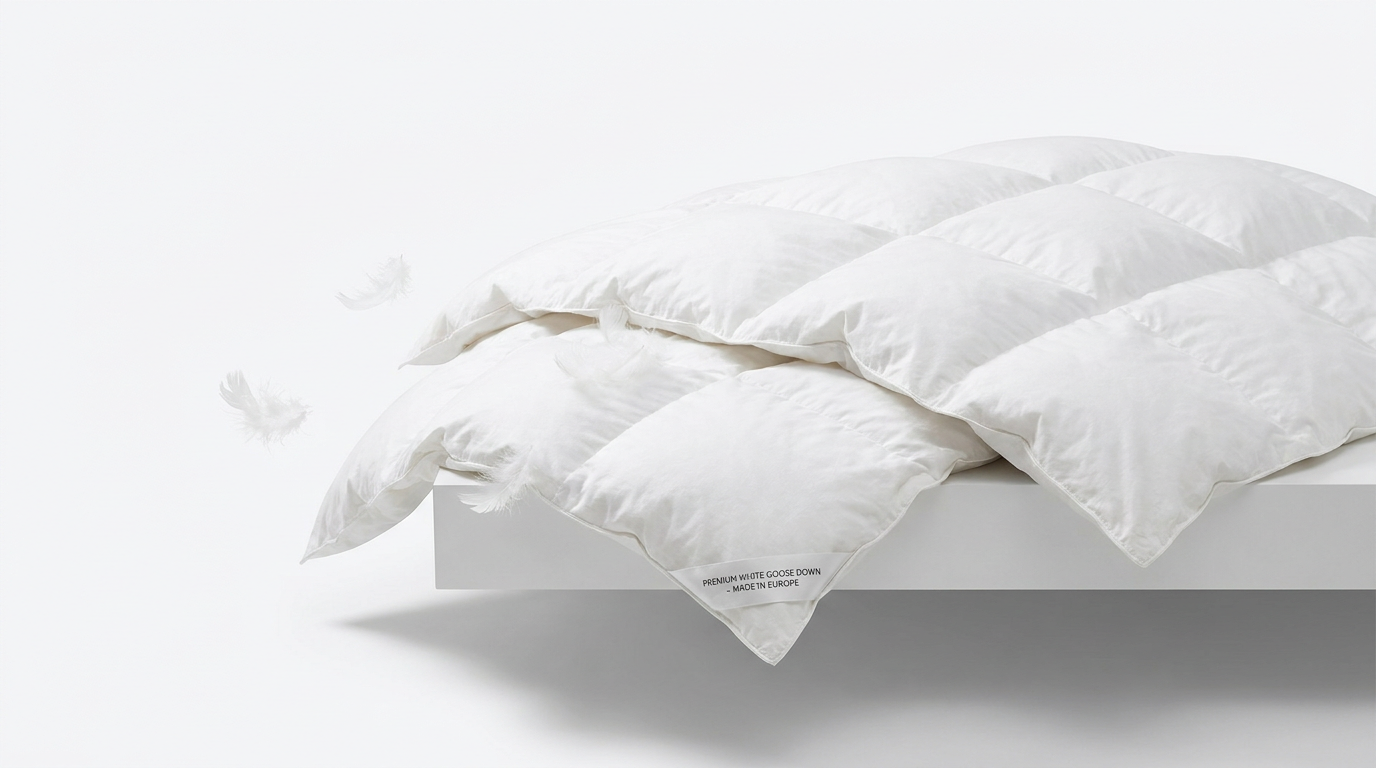
 The loft you see is the air being trapped — and trapped air is what keeps you warm.
Why Two "90% Goose Down" Duvets Are Not the Same Product
Both carry the same label. One sits plump and cloud-like even after years of use. The other settles flat within a season and needs a second blanket by December. The label is accurate on both — the difference lies in three quality measures that rarely appear on the packaging.
Fill Power: Quality of Each Down Cluster
Fill power measures how much volume — in cubic inches — one ounce (28g) of down occupies at its natural loft. The higher the number, the more air each gram of down can trap.
Since warmth in a duvet comes from still, trapped air — not the down fibres themselves — higher fill power means the same warmth level can be achieved with less fill weight. A lighter duvet pressing less on your body throughout the night.
- 500 FP — reliable warmth at a moderate fill weight
- 650 FP — noticeably lighter; good long-term loft retention
- 800 FP — premium lightness; the same warmth as a heavier lower-FP duvet, in significantly less weight
Down Cluster Content: What Percentage Is Actually Down
Down fill is never purely clusters. It also contains feather fibres, fragments, and fine dust. Down cluster content (%) is the proportion of true three-dimensional clusters in the fill.
 The cluster structure is what traps air. More intact clusters, more warmth per gram.
The national standard minimum is 50%. Most market-grade products sit at 60–90%. Premium products reach 90–95%.
Down clusters are the primary unit of thermal performance. A fill with 95% intact clusters will loft more consistently and retain that loft longer than a 70% cluster fill, even at the same declared fill power figure. Higher cluster content also means better fill power stability over time — the duvet keeps its character season after season.
Cleanliness (Turbidity): The Measure You Can't See
Down cleanliness is measured by turbidity — how clear water remains after a standardised wash of the fill sample. Measured in millimetres; higher is cleaner.
- National standard minimum: 500mm
- Premium products: 1,000mm — twice the standard
Low-cleanliness down retains residual oils, dust, and organic material from processing. The consequence most people notice first: a faint but persistent smell in warm or damp conditions — familiar to anyone who has owned a lower-quality down duvet through a British summer.
High-cleanliness down stays fresh. For a product you sleep under every night for years, this is not a minor distinction.
Putting It Together: How the Three Measures Interact
| Fill Power | Cluster Content | Cleanliness | Result |
|---|---|---|---|
| 500 FP | 70–80% | 500mm | Dependable warmth; moderate weight |
| 650 FP | 80–90% | 700mm+ | Lighter feel; good durability |
| 800 FP | 90–95% | 1,000mm | Exceptional warmth-to-weight ratio; long-term freshness |
A practical illustration: to reach an equivalent of 13.5 TOG, a 500 FP fill might require 1,200g of down. An 800 FP fill achieves the same warmth with around 800g — 400g less pressing on your body every night.
Our Fill Power Series
Three levels. Each clearly labelled with fill power, down cluster content, and cleanliness rating — so you can compare on actual performance, not just price.
500 FP for reliable quality at a considered price. 650 FP for the step up in lightness most sleepers notice immediately. 800 FP for those who want the full performance: 95% goose down cluster content, 1,000mm cleanliness — built for the long term.