

 Deep sleep isn't just sleeping longer. It's reaching a specific neurological state — and staying there.
The Sleep You Think You're Getting
Most of us measure sleep in hours. Eight hours is the target; anything less feels like a deficit. But duration is only one dimension of sleep quality. What matters at least as much — arguably more — is what kind of sleep those hours contain.
Your sleep cycles through several distinct stages every 90 minutes or so: light sleep, REM sleep, and deep sleep (also called slow-wave sleep or N3). Each stage serves a different biological function. Deep sleep is where the most critical restoration happens: human growth hormone is released, tissues are repaired, immune function is reinforced, and the brain consolidates the most important memories from the day.
Most adults complete between 4 and 6 sleep cycles per night. Deep sleep is most abundant in the first two or three cycles and becomes shorter toward morning. This means that interruptions in the early part of your sleep — even subtle ones — disproportionately reduce your total deep sleep time.
What Deep Sleep Does That Nothing Else Can
Physical Recovery
During deep sleep, the body's repair processes operate at full capacity. Blood pressure drops. Muscles receive increased blood flow. The pituitary gland releases the majority of its daily growth hormone output. For anyone dealing with physical fatigue, muscle soreness, or the normal wear of an active life, deep sleep is the non-negotiable recovery window.
Cognitive Consolidation
The transfer of information from short-term to long-term memory happens predominantly during deep sleep. Studies consistently show that people who get sufficient deep sleep demonstrate better problem-solving ability, sharper attention, and more stable emotional regulation the following day. The brain isn't resting during deep sleep — it's doing some of its most important work.
Immune Maintenance
Several key immune proteins, including cytokines, are produced in greater quantities during sleep, particularly deep sleep. Chronic deep sleep deficiency has been linked to increased susceptibility to illness and slower recovery. Your immune system quite literally works better when you're deeply asleep.
Hormonal Balance
Cortisol — the primary stress hormone — is suppressed during deep sleep. Ghrelin and leptin, which regulate hunger and satiety, are also balanced by adequate sleep. This is why chronic sleep deprivation is associated not just with fatigue but with increased hunger, weight gain, irritability, and a reduced capacity to manage stress.
What Prevents Deep Sleep From Happening
If deep sleep is so valuable, why do so many people consistently lack it?
Interrupted Sleep Architecture
Any factor that causes brief arousal — even one you don't consciously register — can prevent the brain from completing a full deep sleep stage. You might sleep for eight hours and wake up feeling exhausted because you cycled between light sleep and REM dozens of times without ever reaching the deeper stages.
Chronic Physical Tension
This is the factor most often overlooked: the body's ability to relax completely is a prerequisite for deep sleep. When the muscles and joints of the neck and shoulders are under sustained mechanical stress — held in a position that isn't biomechanically neutral — the nervous system maintains a low level of activation throughout the night. This is enough to prevent the shift from lighter sleep stages into deep sleep.
Many people live with a level of chronic neck and shoulder tension they've normalized. They assume they "just sleep poorly" when the actual cause is eight hours of accumulated postural stress from an unsuitable pillow.
Pressure and Circulation
Sustained pressure on the head and neck from pillow material that doesn't distribute weight evenly restricts blood flow and creates sensory input that keeps the nervous system alert. Even without causing pain, this kind of diffuse physical pressure can meaningfully reduce both sleep depth and sleep continuity.
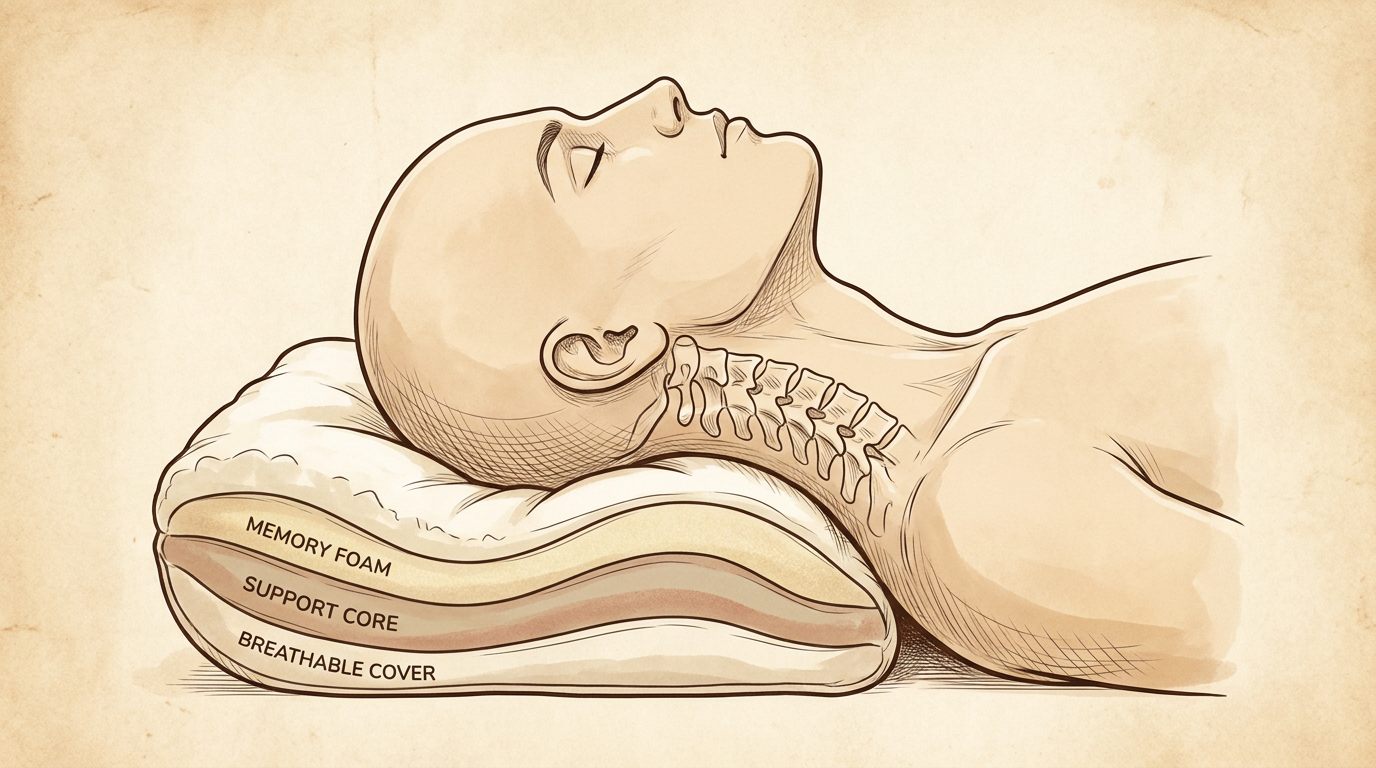 When the cervical spine rests in its natural curve, the muscles stop working — and the nervous system can finally let go.
The Physical Prerequisites for Deep Sleep
Understanding the barriers above leads to a clear set of conditions the body needs to actually access deep sleep:
- Mechanical unloading of the cervical spine — the neck should be supported in a neutral position that requires no muscular effort to maintain
- Even pressure distribution — contact pressure on the head and face should be minimized and spread across as large a surface area as possible
- Active airflow — the sleep surface around the head should allow heat and moisture to dissipate rather than accumulate
- Appropriate height and firmness for body type — there is no universal "correct" pillow height; what's needed is a match between pillow geometry and the individual user's shoulder width, sleep position, and head size
These aren't luxury considerations. They are the physical foundation for what the brain requires to descend into deep sleep and stay there.
The Deep Sleep Series: Engineering the Physical Conditions for Recovery Sleep
Our Deep Sleep Series was developed around the premise that deep sleep isn't a matter of willpower or habit alone — it requires that the body's physical conditions be met first.
The pillow uses a patented dual-layer composite structure: an upper layer of zero-pressure foam that disperses contact pressure across the full surface area on contact — measurably reducing head and neck pressure compared to conventional memory foam — and a lower support layer with a 3–5 second slow rebound that continuously adapts to cervical curvature throughout the night.
The design is available in two anatomically differentiated sizes — based on national adult body dimension data and cervical three-point support theory — to provide appropriate height and contouring for different shoulder widths and head sizes. Certified by Germany's IGR Institute for Ergonomics.
The cover fabric incorporates far-infrared technology that helps neck and shoulder muscles release tension that would otherwise persist through sleep. Airflow rate is 7× that of conventional memory foam pillows, keeping the sleeping surface cool and dry. In a monitored study over 48 days using PSG brainwave analysis, users experienced an average of 25 additional minutes of deep sleep per night.
You can spend years optimizing your sleep habits and still feel like something is missing. Sometimes what's missing is simply a surface that allows the body to stop working and start recovering.